Lingoflow Classroom
Unit 4 Online Life | Page A

Online Life

你的网上生活是什么样的?

Online life: posts, messages and footprints

Watch and think

Do you post too many things online?

你有没有发过照片、评论、视频或消息?
如果后来删掉了,它一定完全消失了吗?

I sometimes post online.
photos | comments | videos | messages

1 Speaking | Social networks

你平时在哪些平台看视频、发消息或看别人发的内容?

People use social media to
Snapchat Pinterest Facebook Twitter Instagram WhatsApp

2 Speaking | Online behaviour check

Read these statements about using social networks. Which of them are true for you?

I’ve got a WeChat account but hardly ever use it.

account = a page or place you use to log in |账号 hardly ever = almost never |几乎不

I don’t post many comments, but I like to read other people’s posts.

post comments = write short ideas online |发表评论 other people’s posts = things other people write online |别人发的内容

I constantly check for updates on social media.

constantly = again and again |不停地 updates = new posts or new information |更新

I sometimes post comments that I regret later.

regret = feel sorry later |后悔 comments = short things you write online |评论

Choose one and say more

Choose one statement. Give one short example.

I sometimes online.

3 Photo prediction

Look at the page. What clues can you see?

What do you think the article is about?

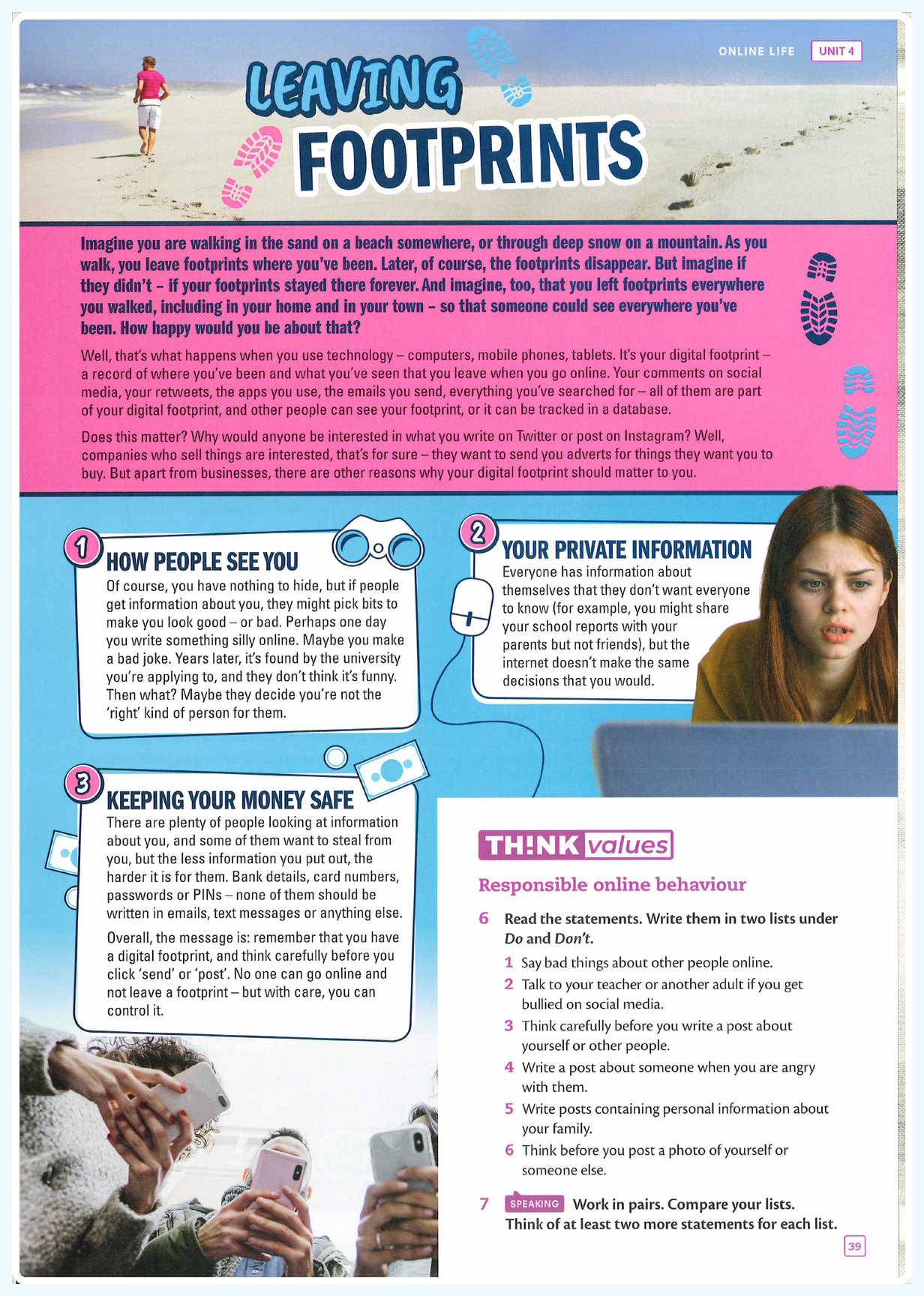
Textbook page preview for Leaving Footprints

Before listening: Read the statements

1 A digital footprint is like a footprint in sand because it disappears after time.
2 People who use the internet create an online history for themselves.
3 What you do online can lead to you receiving certain kinds of advertisements.
4 What you write online can be misunderstood by other people.
5 People should be careful about what personal information they include when they write online.
6 You can make life more difficult for thieves by not putting personal information online.
7 It’s OK to put a credit card number in an email, but not a password.
8 It’s possible not to leave a digital footprint if you go online.
Track 4.01 Read and listen

Full Article Reading Workspace

LEAVING FOOTPRINTS

Imagine you are walking in the sand on a beach somewhere, or through deep snow on a mountain. As you walk, you leave footprints where you’ve been. Later, of course, the footprints disappear. But imagine if they didn’t – if your footprints stayed there forever. And imagine, too, that you left footprints everywhere you walked, including in your home and in your town – so that someone could see everywhere you’ve been. How happy would you be about that?

Well, that’s what happens when you use technology – computers, mobile phones, tablets. It’s your digital footprint – a record of where you’ve been and what you’ve seen that you leave when you go online. Your comments on social media, your retweets, the apps you use, the emails you send, everything you’ve searched for – all of them are part of your digital footprint, and other people can see your footprint, or it can be tracked in a database.

Does this matter? Why would anyone be interested in what you write on Twitter or post on Instagram? Well, companies who sell things are interested, that’s for sure – they want to send you adverts for things they want you to buy. But apart from businesses, there are other reasons why your digital footprint should matter to you.

1 How people see you

Of course, you have nothing to hide, but if people get information about you, they might pick bits to make you look good – or bad. Perhaps one day you write something silly online. Maybe you make a bad joke. Years later, it’s found by the university you’re applying to, and they don’t think it’s funny. Then what? Maybe they decide you’re not the ‘right’ kind of person for them.

2 Your private information

Everyone has information about themselves that they don’t want everyone to know (for example, you might share your school reports with your parents but not friends), but the internet doesn’t make the same decisions that you would.

3 Keeping your money safe

There are plenty of people looking at information about you, and some of them want to steal from you, but the less information you put out, the harder it is for them. Bank details, card numbers, passwords or PINs – none of them should be written in emails, text messages or anything else.

Overall, the message is: remember that you have a digital footprint, and think carefully before you click ‘send’ or ‘post’. No one can go online and not leave a footprint – but with care, you can control it.

Reading Board

4 Read and listen to the article about online behaviour again. Mark the statements T (true) or F (false).

1 A digital footprint is like a footprint in sand because it disappears after time.

F

A digital footprint is not like a footprint in sand because it .

2 People who use the internet create an online history for themselves.

T

3 What you do online can lead to you receiving certain kinds of advertisements.

T

4 What you write online can be misunderstood by other people.

T

5 People should be careful about what personal information they include when they write online.

T

6 You can make life more difficult for thieves by not putting personal information online.

T

7 It’s OK to put a credit card number in an email, but not a password.

F

You should never put a credit card number or a password in .

8 It’s possible not to leave a digital footprint if you go online.

F

It is impossible not to leave a digital footprint if you .

After Reading: Borrow Useful Patterns

把课文句型变成安全提醒。

Borrow the pattern: Everyone / Everything / No one

1. Everyone has information about themselves.

Everyone should be careful online.

2. Everything you’ve searched for is part of your digital footprint.

Everything I do online leaves a footprint.

3. No one can go online and not leave a footprint.

No one should share personal information online.

Final Post

发一条 online safety reminder。

Draft safety post
Everyone has a digital footprint.
Everything I do online leaves a footprint.
I should think before I post.
Posted
No one can go online without leaving a footprint.